| | No fraternal organization has ever been persecuted, maligned, suspected, or blamed more for things that happened in the World than the Freemasonry. This secret society has developed a certain mysticism that intrigues many people because of their behind closed door meetings, secret handshake and passwords. Communists, dictators, religious fundamentalists and even the Catholic Church banned this fraternity centuries ago. Still others think they can manipulate governments just like what happened in Italy decades ago.
But if this group is as evil as feared by some, why would many of our intellectuals, heroes, and martyrs join such a brotherhood? In many instances, Freemasons were not mere participants but leaders of movements. History records them as pioneers, martyrs, heroes, liberators, and nation builders. The French and American and Philippine revolutions had inspiration and leadership of Freemansons.
The tenets
Members explain that Freemasonry is a voluntary association of men, a fraternal society. It is a system of moral conduct, and a way of life. It is religious in its character, teaches the Golden Rule and morality through symbolism. It uses secret rites and ceremonies. It is based on a firm belief in the Fatherhood of God, the Brotherhood of Man and the Immortality of the Soul. Its great tenets are: Brotherly love, Relief, and Truth. Its motto was used in the French revolution “Liberty, Equality, Fraternity.” Their sacred triangle can be found in the American dollar and the Philippine Flag. In its ranks you can find Christians, Buddhists, Muslims, Hindus, Catholics, and even followers of Confucius embrace each other as brothers. Are they not the forerunner of ecumenism that the Churches are just fulfilling now?
Albert Pike expresses the libertarian principles of the brotherhood ”Masonry is engaged in her crusade, - against ignorance, intolerance, fanaticism, superstition, uncharitableness, and error. She does not sail with trade-winds, upon a smooth sea, with a steady free breeze, fair for a welcoming harbor; but meets and must overcome many opposing currents, baffling winds, and dead calms.”
Because the Spaniards, Americans, the Church and our very own elite society wanted to hide their atrocities, they censured our history and the truth was never revealed. Even the two novels of Rizal were banned for decades. Because Filipino Masons were able to hide and preserved records, their archives are a great source of historical facts.
In researching these achieves, we found out that four of our Presidents were Masons, Gen. Emilio Aguinaldo, Manuel Quezon, Manuel Roxas, and Jose P. Laurel the puppet Government during the Japanese occupation.
Most of the leaders of the Spanish revolution were masons - Graciano Lopez Jaena, Dr. Jose Rizal, Marcelo H. del Pilar, Emilio Aguinaldo, Andres Bonifacio, Apolinario Mabini, Jose Alejandrino, Antonio and Juan Luna and many others. During the American and Japanese era we had Manuel Quezon, Sergio Osmena, Manuel Roxas, Jose Abad Santos, Gen. Douglas MacArthur, Gen. Vicente Lim, Dr. Jose P. Laurel, Claro M. Recto, Camilo Osias, Benigno Aquino Sr. and many more.
Persecutions
During the Inquisition, Freemasonry was one of those banned and actively persecuted by the Church and kings of Europe. A Royal letter Patent issued by the Council of Regency of Spain was the first official prohibition of Masonry. In 1814, Ferdinand VII of Spain abolished the constitution and re-established the Inquisition.
The Roman Catholic Church considered Masonry then as godless, anti-Christ and heretics. The Masons in the Philippines waged a long, arduous struggle for religious freedom and against bigotry.
In the 1872 Cavite mutiny, along with three Filipino priests Burgos, Gomez and Zamora 13 martyrs were executed, seven were Freemasons.
In July 2, 1896, a Royal Degree was issued in Spain ordering more stern measures against member of the Masonic Order in the Philippines. “Secret societies among them and very specially Masonry have used their influence widely and regrettably in a most disruptive manner, in our colonial problems. These societies, by the mere fact of being secret, are illicit and illegal, harmful in every state and a source of insidious evil in a territory like the Philippines.
During the reign of terror (1895-1897) our national hero Dr. Jose Rizal was executed by firing squad in Bagumbayan, now Rizal Park Dec. 30, 1896 for being a Freemason. Days after, 11 other masons were executed including Ariston Bautista, Faustino Villaruel, Luis Villareal, Agustin de la Rosa, et. al. They were blamed for the growing rebellion against the injustice and abuses of the Spaniards and friars. The suppressive Spanish rule lasted more than three centuries (1665-1898).
The Japanese authorities during their Philippine occupation looked upon Masonry with aversion and revenge. They claim the Masonic and Shrine movement originates in Paris and is a Jewish revolutionary organization designed to overthrow established government… indirectly, that they must be persecuted, tormented, humiliated, reviled without respite. Supreme Court Justice Jose Abad Santos, a mason was executed in Malabang, Lanao for refusing to cooperate. Grand Master John R., McFie was killed by Japanese shell while interned at U.S.T. (Concentration camp), Deputy Grand Master Jose P. Guido was beheaded in the presence of his family; Jose de los Reyes, P.G.M. was also killed.
And because Masons never answer allegations, nor are allowed to brandish their good deeds, their mysticism continued.
Beginning
Although Masonry existed in the Philippines even before 1756, the first Filipino initiated was Jacobo Zobel, an ancestor of the Ayala and Zobel Business Empire. In 1871 King Amadeo of Spain appointed Lt. Gen. Rafael de Izquierdo as Governor General of the Philippines. They were both masons.
It was during the term of Grand Master Miguel Morayta in 1889 that masonry was opened to the natives. Others were able to join abroad before that. In April 1, 1889, Graciano Lopez Jaena in Barcelona, Spain founded Lodge Revolucion. This was later dissolved and Lodge Solidaridad was formed. Jose Rizal, Mariano Ponce, Marcelo H. Del Pilar, Jose Alejandrino, Antonio and Juan Luna and Pedro Serrano Laktaw were initiated here. It was this group of intellectuals who petitioned the Spanish Parliament for the restoration of Philippine Parliamentary representation. They called attention to the sad fate of the Philippines that languished under the shadow of intolerance and tyranny. They published the La Solidaridad newspaper to further their cause. They implored the support of masons all over Europe. Marcelo H. del Pilar and Pedro Serrano Laktaw were appointed to organize Philippine Masonry. It was through this secret society that the Noli and Fili were distributed discretely among Filipinos and it took sometime before it was discovered. It had already opened the eyes of Filipino intellectuals.
In July 3, 1892 Dr. Jose Rizal founded the Liga Filipina, a peaceful, civic association of Filipinos aimed at seeking reforms. Its motto was Unus Instar Omnium (One Like All.) Four days after, Rizal was arrested and imprisoned at Fort Santiago and then deported to Dapitan until July 31, 1896.
Andres Bonifacio the “great plebeian” with fellow masons Valentin Diaz, Teodoro Plata, Ladislao Diwa and Deodato Arellano founded the Katipunan July 7, 1892 in Azcarraga St., Tondo, Manila. Its initiation rites and secrecy was similar to the Freemasons. By 1896 this revolutionary society swelled to 100,000 members. On August 19 of that year Spanish authorities discovered its existence by the confession of the wife of a Katipunero to a parish priest. Many members and sympathizers of the movement were arrested. In August 26, the “Cry of Balintawak,” was shouted.
Later, a new revolutionary leader arose from Kawit, Cavite. Emilio Aguinalo was inducted to Freemasonry in Imus January 1, 1895. He was initiated by Bonifacio in the Katipunan. But while Bonifacio believed that the Katipunan should carry on the fight, Aguinaldo as a military leader insisted that a new revolutionary government should be established to supervise the struggle. On October 31, 1896 Aguinaldo issued at Kawit his manifesto proposing that the new government shall be based on the principles of “Liberty, Equality, Fraternity” the motto of masonry.
Spanish-American War
In April 25, 1898, the United States declared war against Spain. Aguinaldo who was exiled in Hong Kong was approached by emissaries of Admiral Dewey to collaborate with the Americans to defeat the Spaniards in the Philippines. Arms were supplied and Aguinaldo was spirited to the country. On May 24, 1898 General Aguinaldo proclaimed the establishment of the Dictatorial Government followed by the proclamation of Philippine Independence at Kawit on June 12. Another Mason, Apolinario Mabini was responsible for laying down the foundations of the First Philippine Republic. He was Premier and Secretary of Foreign Affairs in the first Cabinet of President Aguinaldo. Antonio Luna, another Freemason was Director of War.
Separation of Church and State
During the promulgation of the Constitution of the Philippine Republic in Malolos in 1899, the Masons led by Antonio Luna fought and won the separation of Church and State. Felipe Calderon, another delegate proposed Catholicism be the state religion.
In the Constitutional Convention of 1935, 41 delegates were Masons; among them were Manuel Roxas, Jose Laurel, Camilo Osias, Conrado Benitez, Rafael Palma, Pedro Guevarra, and Vicente Francisco. They incorporated the Masonic Principles and saw to it that “No religious test shall be required for the exercise of civil or political rights.”
Later, two Masons, Claro M. Recto and Jose P. Laurel sponsored a bill for all students to study the banned Rizal books, Noli and Fili.
Filipino-American war
The Americans did not honor their word with Aguinaldo that independence will be granted to the Filipinos after Spain was defeated. The Treaty of Paris ceded the country to the Americans and it started the Fil-American war. Against a powerful war machine, the Filipinos with shortage of arms could not win the war. In March 23, 1901, General Funston arrested Aguinaldo. He was imprisoned in Malacanang Palace but was treated well by a fellow mason, Gen. Arthur MacArthur who was the Military Governor General.
To expedite the transfer of the government from military to civilian authorities, Pres. William McKinley, a mason appointed the First Philippine Commission (Schurman Commission) on January 20, 1899. The Second Commission (Taft Commission) was appointed March 16, 1900 with legislative and executive powers. A Civil Government was inaugurated July 4, 1901 with Judge William H. Taft, as first Civil Governor. Taft was also a mason. He popularized the “Philippines for the Filipinos”. He worked for the passage of the Philippine Bill of 1902 establishing complete civilian government.
In July 31, 1899, Ambrosio Flores, Grand Master beseeched the American Masons to use their influence to end the war and recognize the independence of the Philippines. Rafael del Pan was commissioned to coordinate with American Masons. Mark Twain, and other Masons led the media campaign to sway the American public. Masons in the U.S. Congress and Senate sponsored bills to give back independence.
When the Americans were debating whether the Filipinos were civilized or barbarians due to the massacre of an Infantry in the Visayas by women of a Village whose husbands were murdered by that Infantry, a U.S. Senator, a Mason stood before the august body and read the poem of Dr. Jose Rizal “Last Farewell” and asked, “Is this the work of a barbarian.” This ended the debate.
The proclamation of the existence of complete peace in the Philippines was by President Theodore Roosevelt, also a Mason raised in Long Island, New York. Filipinos then began to organize political parties. An election of all-Filipino delegates for the First Philippine Assembly was held. Sergio Osmena was Speaker and Manuel Quezon as majority floor leader. Both were Masons.
In 1913, under President Woodrow Wilson’s administration, Francis Burton Harrison, another Mason was appointed governor-general. He placed within the reach of the Filipinos the instruments of their redemption. He worked for the Jones Law of 1916 - Philippine Autonomy Act - which stated the purpose of the United States is to withdraw their sovereignty over the Philippine Islands and to recognize their independence as soon as a stable government can be established. Harrison Filipinized the Government and at the end of his term in 1921 it was 96% controlled by Filipinos.
During all these times, missions were formed to work for the independence of the Philippines, majority of them were chaired and manned by Masons - Manuel Quezon, Sergio Osmena, Pedro Guevarra, Camilo Osias, Rafael Palma, Rafael Alunan, Emilio Tria Tirona, Teodoro Yangco, Filemon Perez, Ceferino de Leon, Tomas Earnshaw, Quintin Paredes, Jose Abad Santos, Conrado Benitez, Jorge Vargas, Maximo Kalaw, Arsenio Luz and others. They worked and influenced masons in the U.S. Government, the media and the Masonic Lodges all over America.
As early as January 12, 1916, Senator James P. Clarke, a member of Western Star Lodge No. 2 of Arkansas introduced an amendment to the Philippine Bill, which would grant independence to the Philippines within a few years. His amendment was approved by the U.S. Senate, but was defeated in the House of Representatives by a slim margin, thus the Filipinos had to wait another 40 years before Philippine independence was finally proclaimed by the United States.
The first Philippine Independence measure passed by the American Congress was the Hare-Hawes-Cutting bill vetoed by Pres. Herbert Hoover. Another mission led by Senate President Quezon secured the passage of the Tydings-McDuffie Law approved on March 24, 1934 by Pres. Franklin D. Roosevelt, a Freemason of New York City. It called for a Constitutional Convention to frame the Constitution of the Philippines. It provided for Commonwealth Government and upon the final withdrawal therefrom of United States sovereignty, said Commonwealth shall be known as the Republic of the Philippines. Manuel Quezon became President and Sergio Osmena as Vice President.
World War II
The Japanese bombed Pearl Harbor and the Philippines on December 8, 1941. The United States Armed Forces in the Far East (USAFFE) was under Lt. Gen. Douglas MacArthur, inducted as member at Manila Lodge No. 1. Because the Americans gave Europe priority in the war and send no support, the Philippines lost the battle. Brigadier Gen. Vicente Lim, a Mason was in charged of 7,000 officers and men of the 41st division, which became known as the “Rock of Bataan” was in the frontline of the battlefield. Out of the 78,000 Fil-American troops in Bataan, only 4,000 were Americans and they were held at the rear as reserves. Vicente Lim was the first Filipino to graduate in West Point with former President Dwight Eisenhower in 1914.
As we know, the Japanese expected the country to fall in days but the fighting lasted for four months giving time for the Allied forces to re-arm and save Australia and New Zealand from invasion. In April 9, 1942, Bataan fell. Prisoners were forced to march from Mariveles, Bataan to San Fernando, Pampanga. Those who survived the summer heat, hunger, thirst, disease, and execution were herded into trains to Capas Tarlac Concentration Camp. More than 40,000 soldiers were estimated to have perished in this battle. In the airwaves that day, Voice of Freedom echoed, “Bataan has fallen, but the spirit that made it stand, a beacon to all the liberty loving people of the world cannot fall.” On May 6, 1942 Corregidor fell.
Dr. Jose P. Laurel of Batangas Lodge with fellow masons Jorge Vargas, Rafael Alunan, Antonio de las Alas, Quintin Paredes, Camilo Osias, Benigno Aquino Sr. and others were ordered to serve the Japanese colonizer, a puppet government. Laurel was appointed President. They accepted their duties to ease the pains of their people and lessen the damage. Most of the masons however refused to submit to the new invaders and joined the Guerrilla resistance movement.
President Quezon with his family and other masons left for the United States early in 1942 to influence the government to support the war in the Pacific and give independence to the Philippines. Gen. Douglas MacArthur fought hard to convince the Americans to come to the aid of their colony. In June 29, 1944, the American Congress passed Joint Resolution No. 93 authorizing the President of the United States to proclaim the independence of the Philippines on July 4, 1946.
Gen. MacArthur returned October 20, 1944 landing in Leyte and the Philippine Commonwealth was restored October 23, 1944 with Osmena as President. Quezon died in Saranak Lake, New York August 1, 1944 never to see the fruits of his efforts. Manuel Roxas followed as President of the Commonwealth April 23, 1946. In July 4, 1946, the Philippine Independence was proclaimed at the Luneta. U.S. President Harry Truman’s Proclamation was read by High Commissioner Paul McNutt, both were masons.
After the war, Gen. MacArthur helped spread the seeds of Philippine Masonry in Japan, Korea and Saipan. In 1955, Prime Minister of Japan Ichiro Hatoyama, and Yahachi Kawai, President o the House Counselors of the Japanese District were introduced to the mysteries of Freemasonry under Philippine jurisdiction.
Other contributions
The first labor union, the Union Obrera Democratico Filipina was founded by Isabelo de los Reyes, a mason. In 1902, May 1, Dr. Dominador Gomez led the first Philippine Labor Day. Act. No. 1818 was passed 6 years later declaring May 1 Labor day. Gomez was a mason too.
Bishop Gregorio Aglipay, founder of the Philippine Independence Church was a Mason. The Katipunan took control of many of the Roman Catholic Churches and gave it to the Aglipayan Church. The Americans gave it back.
Pres. Carlos P. Garcia paid tribute to the Masonic fraternity. “I cannot help but take cognizance of the great and noble work which your grand fraternity had done and is still doing for freedom of thought and conscience, for democracy and for equality. In our country and in the U.S., members of your brotherhood led in the fight for the sacrosanct cause of liberty, equality and fraternity.
The late Rafael Salas, the brilliant Executive Secretary of Pres. Ferdinand Marcos who resigned because he cannot stand the abuses was a member of the Order of Demolay, a Masonic fraternity for young men. Salas became the head of the Population Control of the United Nations.
During the years of Marshal Law, Sen. Jose Diokno, a mason fought fearlessly against the evils of the Marcos regime. He was imprisoned with Sen. Benigno Aquino and accused of being too friendly to the NPA but contributed much to the nationalistic cause. Justice Calixto Zaldivar stood pat on his principles defying the dictatorship. He also was a mason.
At the EDSA revolution, Worshipful Master Col. Tirzo Gador who was the provincial commander of Cagayan at that time led one hundred Cagayanos in defense of the rebellion. The so-called “Cavaliers” composed of Masons surrounded Gen. Rene Cruz, Senior Warden of Araw Lodge No. 18 in Camp Crame. Past Grand Master Rosendo Herrera - together with his family - defied tanks in that glorious EDSA experience. Past Grand Master Reynato S. Puno, Deputy Minister of Justice, met with Senator Jovito Salonga when Justice Estelito Mendoza was nowhere to be found.
MW Teodoro M. Kalaw, past Grand Master of the Philippines observed: “In these days of peace and goodwill, under a government that neither condemns nor persecutes, but rather encourages and helps those who work for the benefit and progress of humanity, Masonry which is a universal institution to which many honest men belong, irrespective of religion, race or nationality, will be able to teach the Filipinos that the ideal life is that in which nobody interferes with the beliefs of others; in which everybody may profess the ideas that each considers best, if within the law; in which everyone is free to adore his God in his own way; in which all may practice as they deem advisable the commandment of “Love they neighbor as thyself; charity towards the needy, tolerance and humility towards the poor, justice and truth towards all; in which there is no hatred, but love, no division of classes, but fraternal cooperation, no monopolies for the few, but opportunities for everybody; and in which all will understand that morality is not expressed in words, or even in thoughts, but in daily deeds, in every industrial, commercial, agricultural activity, in every phase, in short, in human existence.”
Even today, Masons are working for the preservation of our freedom, equality, unity and peace. Truly, the words “Masonry is in the heart of great men among nations” was upheld. Perhaps if more Masons were involved in our Government and Filipino Communities abroad, our dream of unity will be hastened. But many seem to be content with following the blind rather than leading them.
| | |


 Fetching Diego


 I was looking for more information on the great grandfather of my cousin - Tomas Noguera Earnshaw, the FIRST MAYOR OF MANILA. More on him in succeeding posts.


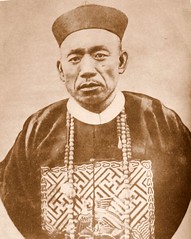 His life was a classic rags-to-riches story: Born of a poor family in T’ung-an hsien, he migrated to the Philippines in 1844. Although starting out in a measly position in the textile business, through hard work, tenacity, and acquired connections, he prospered.
 Source: